

Slippage is the difference between the price a trader expects and the price at which an order is executed. Slippage is one of the most misunderstood costs in forex trading. Many retail traders focus on spreads, commissions, and swap fees, but the difference between the price a trader expects and the price they actually receive can have a meaningful impact on performance, especially over many trades.
Slippage is a normal consequence of trading in a market where prices, liquidity and order availability change continuously, such as the forex market. Normal slippage is usually caused by price movement and a change in available liquidity. The time required to transmit and process an order means that the price you see on your screen might be old by the time your order hits the place where it can actually be executed. These conditions are created by the market rather than controlled by an individual broker.
Traders should expect some slippage, include it in risk calculations, and examine whether favourable and unfavourable movements are treated the same way by the broker. Slippage can happen in either direction, which means that it can produce a better or worse execution price for the trader.
The market movement responsible for genuine slippage is not controlled by the broker. The broker does, however, control liquidity access, routing, and execution parameters, which can impact the risk of slippage occurring. Brokers decide how orders are routed, which liquidity sources are used, and how execution tolerances are applied. A broker does not control the market movements that create slippage, but it does control parts of the system used to process that movement, and your choice of broker can impact how much slippage your will experience.
Slippage can be either negative or positive. Negative slippage occurs when a trader receives a worse execution price than the expected price. Positive slippage occurs when the trader receives a better price than the expected price. Traders often notice (and talk about) negative slippage more, because it directly reduces profits or increases losses.
If a broker consistently passes negative slippage on to the trader while retaining positive slippage for itself, the trader will experience asymmetric slippage. Whether this practice violates regulations depends on the jurisdiction and applicable best execution requirements. In some jurisdictions, brokers are required to act in the client’s best interest and provide fair and transparent execution. Deliberately disadvantaging clients through asymmetric slippage can violate that rule, especially if it is not accompanied by very clear disclosure information. For a broader breakdown of systemic execution risks and how brokers manage order-routing safety, see my guide on trade slippage safety on DayTrading.com.
What Is Slippage In Forex?
Slippage occurs when an order is filled at a different price from the one displayed or requested when the trader submitted the order.
Suppose EUR/USD shows an ask price of 1.08500. A trader places a market order to buy one standard lot but receives an execution price of 1.08505. The difference is 0.00005, equal to half a pip. The trader has paid more than expected, which means negative slippage. In this case, there was half of pip of negative slippage.
If the order had been filled at 1.08496 instead, the trader would have received a price four tenths of a pip below the expected ask. This is positive slippage because the purchase was completed at lower price than the one expected by the trader.
To understand slippage, we need to remember that the price shown on a trading platform is a current quote, not a permanent reservation. The market may update during the interval between the trader pressing the order button and the execution system processing the request.
Negative slippage occurs when the final price is worse than the expected price.For a buy order, a higher execution price is negative. For a sell order, a lower execution price is negative. Positive slippage works in the opposite direction. A buy is filled below the expected price, or a sell is filled above it. Suppose USD/JPY shows an ask of 150.200 and a trader sends a market buy. A fill at 150.215 is negative slippage because the trader paid 0.015 yen more per dollar. A fill at 150.190 is positive because the trade opened below the expected ask. Both outcomes are possible because prices can move in either direction during order transmission.
How To Calculate And Measure Slippage
For a buy order, adverse slippage is execution price minus expected ask price.
For a sell order, the calculation is expected bid price minus execution price.
More formally:
This way, positive values always represent negative (adverse) slippage.
Examples:
- A trader sends a market order to buy one standard lot of EUR/USD at an ask of 1.08000, but the order is filled at 1.08007. The difference is 0.00007 which is the same as 0.7 pips. One pip on a standard EUR/USD lot is normally worth $10. The approximate slippage cost is therefore $7.
- A positive fill at 1.07996 would represent 0.4 pips of improvement, worth approximately $4 on the same position size.
Slippage Monetary Impact Calculator
Calculate the precise pip difference and actual financial cost (or gain) of an execution delay based on your position size.
Slippage should be measured against the executable bid or ask recorded when the order was sent. Comparing a buy execution with the chart’s mid price incorrectly counts part of the spread as slippage.
When you keep records to evaluate a broker, useful records include the expected price, executed price, trade direction, order size, submission time, fill time, and order type. Market conditions should also be noted. Results should be grouped by individual currency pair and session. Grouped by individual currency pair, because the average slippage across the super liquid major pair EUR/USD and an exotic currency pair such USD/KES as tells the trader little of value, because the two instruments have such different liquidity characteristics. Grouped by session, because a strategy might record average slippage of 0.2 pips but occasionally suffer 20-pip fills during news events. The average looks harmless, while the tail risk can still destroy the expected return.
How A Forex Order Reaches The Market
The foreign exchange market does not operate through one central exchange with a single public order book. It is an over-the-counter (OTC) market made up of a variety of participants, including banks, non-bank market makers, electronic communication networks (ECNs), prime brokers, liquidity providers, hedge funds, trading firms, and other counterparties.
Liquidity providers are particularly important because they supply the prices and liquidity that allow brokers and other market participants to execute trades. A forex broker may connect to one or more liquidity providers, depending on its business model and execution setup. The quality, depth, and speed of available liquidity can influence spreads, execution quality, and the amount of slippage traders experience.
In their Quarterly Review (December 2019), the Bank for International Settlements (BIS) describes forex execution as fragmented across different electronic platforms, dealer systems and trading relationships. Prices can vary slightly between venues because each venue has its own liquidity, participants, and update speed.
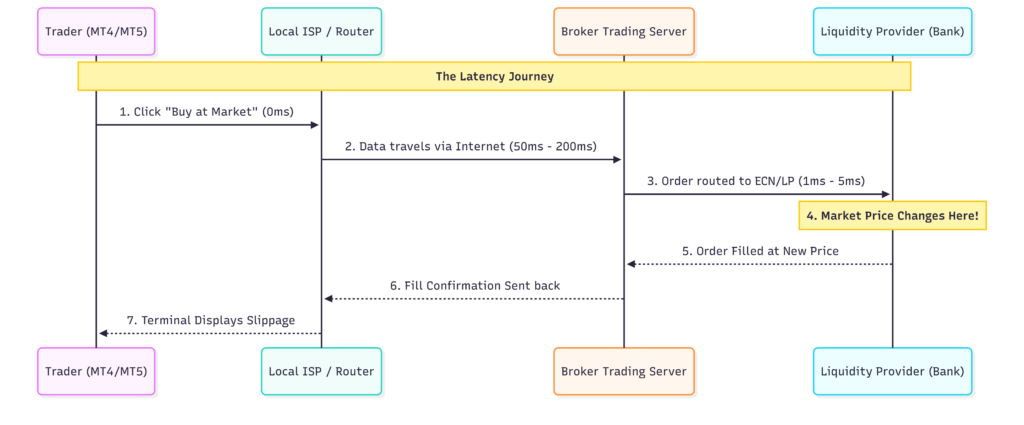
When a retail trader submits an order, it does not become a completed trade at the exact instant the mouse button or screen is pressed. The request first leaves the trading device. It travels through the trader’s internet connection, reaches the broker’s server, and passes through the broker’s pricing and risk controls. Depending on the broker’s model, the order may then be matched internally, offset against another client position, or routed to an external liquidity provider. The execution system confirms whether the requested amount can be filled at the available price. This process can take milliseconds in normal conditions. That may sound too fast for a meaningful price change, but electronically traded currency prices can update several times during the same interval.
What Causes Slippage?
Slippage is commonly associated with market orders. A market order gives priority to completion rather than an exact price. The principle is that execution may be highly likely while the final price remains uncertain. A market order is designed for execution as soon as possible, but does not guarantee the execution price.
Slippage normally appears when the available market price changes or when the requested trade is larger than the quantity available at the first quoted level.
The amount of slippage can depend on factors such as volatility, liquidity, order size, connection speed, trading hours, and the type of instruction submitted.
Rapid Price Movement
If EUR/USD moves from 1.08500 to 1.08506 before your buy request reaches the execution system, the original ask may no longer be available. If it was a market order, you can experience slippage.
Fast movements are common when the forex market is reacting to news, e.g. interest-rate decisions, inflation reports, employment data, election results, government announcements, or geopolitical events. Traders and automated systems respond to the same information at nearly the same time. Quotes are cancelled, replaced, and moved. In reaction to the news, market participants are reassessing the currency’s value in relation to the other currency.
Scheduled news does not have to surprise the market to create slippage. Even a result close to expectations can produce a quick adjustment where positioning was heavily biased in one direction. The effect can be more severe when the reported figure differs sharply from forecasts, and prices may jump between levels rather than trade smoothly through each fraction of a pip.
Reduced Market Liquidity
Liquidity refers to the ability to buy or sell an asset quickly and efficiently without causing a significant change in its price. A liquid market has enough available buyers and sellers, or enough orders at nearby prices, to absorb trading activity without large price movements.
Major currency pairs such as EUR/USD, USD/JPY, and GBP/USD are highly liquid because they attract large trading volumes from banks, institutions, corporations, and other market participants.
When liquidity is lower, there may be fewer available orders at the current price level. A large order may then need to be filled across multiple price levels, which can contribute to wider spreads and increased slippage. Even if a trader has a fast connection, an order may still experience slippage if there is insufficient liquidity available at the requested price. Conversely, a liquid market with deep available pricing can often absorb orders with less price movement.
Liquidity can fall at certain times of day. The period around the daily forex rollover may for instance contain fewer active participants and have wider spreads. Public holidays can also reduce activity in one or more financial centres.
Liquidity may also be withdrawn during market stress. FCA research into liquidity provision in electronic forex markets found that different liquidity providers react differently to volatility and scheduled economic news. Its study also found that some high-frequency liquidity was withdrawn almost entirely during the extreme market conditions surrounding the 2015 Swiss franc event.
A market can therefore appear liquid during ordinary trading and become much thinner within seconds. The quote visible before an announcement may not represent the amount available after the announcement.
Order Size And Market Depth
A displayed price may only be available for a certain quantity. A trader requesting more than that quantity can receive several fills at different levels.
Suppose the best ask in EUR/USD is 1.09000 for €500,000. The next ask is 1.09002 for €700,000 and another €800,000 is available at 1.09005.
A market order to buy €100,000 may be completed at 1.09000. An order to buy €1 million could use all €500,000 at the first price and €500,000 at the second. The resulting average fill would be 1.09001.
This is slippage caused by market depth. No single liquidity provider had enough volume at the top price to complete the full order.
The BIS report on forex execution algorithms notes that execution prices depend partly on transaction size, prevailing liquidity, and market volatility. Large institutional users often divide orders into smaller amounts to reduce market impact, though this creates timing and execution risks. Retail order sizes are usually very small relative to major interbank currency flows, but size can still matter on less liquid instruments, during volatile periods, or when the broker has access to a narrow group of liquidity sources.
Latency
Latency is the delay between sending information and receiving a response. In trading, it includes the time needed for the order to travel from the customer’s device to the broker and through the execution system, and then back again.
The trader´s set up matters. A slow computer and a low-quality WiFi connection can increase latency, and using slow or unstable internet connection makes it even worse. Distance from the broker’s trading server can add further delay. All put together, these various factors increases the risk that the displayed quote will change before the request arrives.
The broker’s own infrastructure also matters. An overloaded server, slow bridge connection, or delayed price feed can increase execution time.
Market Gaps
A price gap occurs when the next available quote is materially above or below the previous quote.
Weekend gaps are a common example. A currency pair may close on Friday and reopen on Monday at a different level after political, economic, or military events occur while retail trading is closed. There may be no executable price between the Friday close and Monday open. A stop loss placed inside that gap cannot be filled at its trigger level because no counterparty was available at that price. The same effect can occur during an unexpected intraday shock. Quotes may disappear briefly and return several pips away.
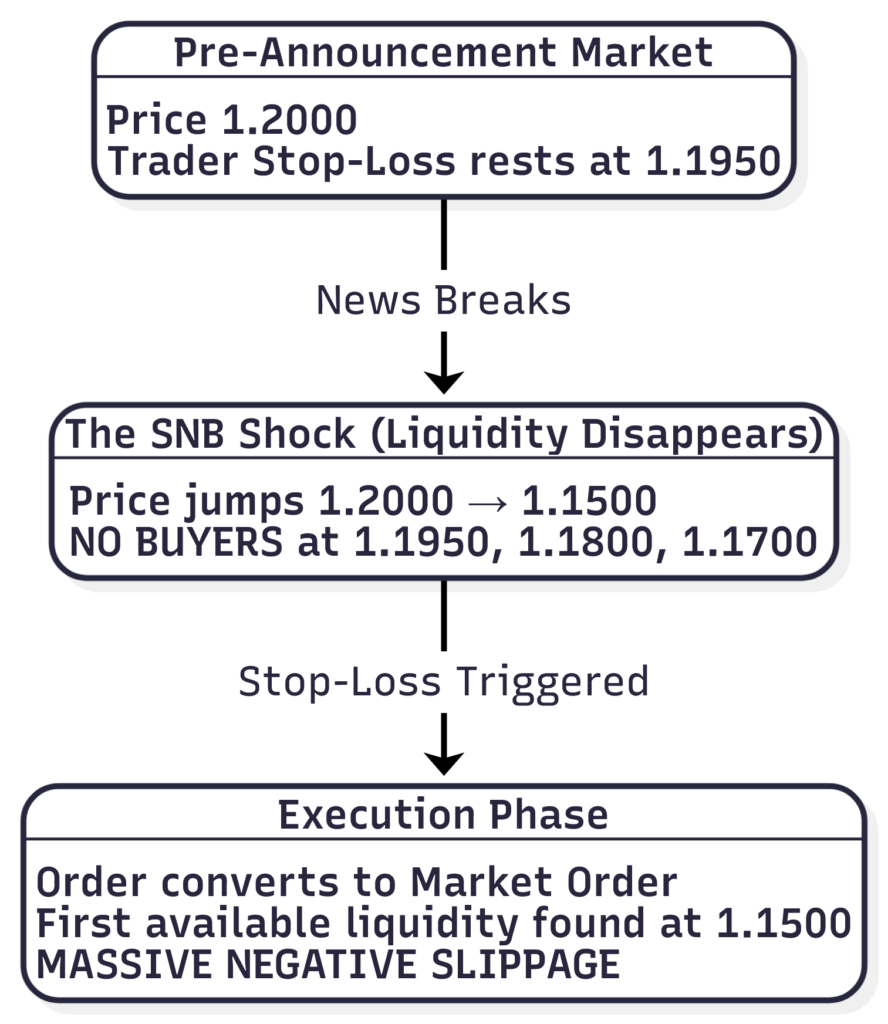
The Swiss franc shock of January 15, 2015 is one of the clearest examples of how this type of market gap can occur in forex. To understand the events of January 15, we need to understand the background. From the late 2000s, the Swiss franc (CHF) had been appreciating sharply against the euro during the European sovereign debt crisis because investors viewed the Swiss franc as a safe-haven currency. The Swiss National Bank (SNB) intervened in the foreign exchange market to slow the appreciation, because a stronger franc makes Swiss exports more expensive, reduces the competitiveness of Swiss businesses abroad, and increases the risk of deflation by making imported goods cheaper. On 6 September 2011, the SNB went further than before by introducing a minimum exchange rate of EUR/CHF 1.20, committing to buy foreign currency in unlimited quantities to prevent the CHF from strengthening beyond that level.
On January 15, 2015, the SNB unexpectedly announced that it was abandoning this minimum exchange rate policy. The forex market reaction was immediate and extreme. Under normal conditions, forex prices for majors and minors move continuously because there are usually many buyers and sellers providing liquidity at nearby prices. If one trader wants to sell, there are often other participants willing to buy close to that price. During the Swiss franc shock, that normal process broke down. When the SNB removed its support for EUR/CHF 1.20, many market participants immediately tried to sell euros and buy Swiss francs. However, there were not enough buyers of euros available near the previous price levels.
The result was a sudden repricing:
- EUR/CHF was trading around 1.20 before the announcement.
- Within minutes, it fell dramatically, at one point dropping close to 0.85 on some price feeds.
- The market moved through many price levels without executing trades at every intermediate price.
Instead of a smooth move like:
1.2000 → 1.1999 → 1.1998 → 1.1997
the market experienced something closer to:
1.2000 → 1.1500 → 1.1000 → 1.0500
This gaps appeared because there was insufficient liquidity available between those prices.
Many traders had stop-loss orders placed near the 1.20 level, assuming the SNB would continue defending that price. However, a stop-loss does not guarantee execution at the exact stop price. Once triggered, it usually becomes a market order (depending on platform and settings).
When the market suddenly moved lower:
- The stop-loss was activated and generated a market order to sell.
- The market order searched for available liquidity.
- There were few or no buyers near the expected price.
- The trade was filled at a much worse price, and the trader experienced serious negative slippage.
For example: A trader may have had a stop-loss to sell EUR/CHF at 1.1950. The market jumped through that level, and the order was not filled until 1.1500. This is negative slippage caused by a liquidity gap, not simply slow internet or broker execution delays.
The Swiss franc shock demonstrates that slippage is not only caused by latency. Even a trader with the fastest possible connection cannot avoid slippage when the market itself lacks liquidity. Latency determines how quickly an order reaches the market, but liquidity determines whether there are enough available prices to execute that order.
- Latency problem: The market moves while your order is travelling.
- Liquidity problem: The market has moved because there are not enough counterparties willing to trade at previous prices.
During the Swiss franc shock, the dominant issue was a sudden disappearance of liquidity and a massive price gap. For traders, the lesson is that even excellent infrastructure cannot eliminate slippage during extreme events. Fast execution can reduce avoidable delays, but it cannot create liquidity where none exists. The Swiss franc shock also showed very clearly that stop-loss orders is not enough to ensure that a leveraged account is prevented from falling below zero.
Is Slippage Controlled By The Broker?
Normal market slippage is not directly controlled by the broker. A broker cannot prevent central-bank news from removing exchange rate pegs, force liquidity providers to quote during a crisis, or create orders at prices where no market participant is willing to trade. A broker can also not remove the time required for an order to travel through an electronic system. Technology can reduce that interval, and some systems are extremely fast today, but it cannot make it literally zero.
While slippage can occur without any misconduct by the dealer, it does not mean that brokers have no influence over slippage. Their setup impacts the order and execution process, and categorically stating that brokers never affect slippage would be wrong. The more accurate statement is that brokers do not normally control the market conditions that generate slippage, but they do control important execution rules, business choices, and infrastructural decisions that in turn impact how traders will experience slippage.
Pricing And Liquidity Sources
The broker decides which banks, non-bank market makers, or other providers that will contribute to its pricing. Another broker may combine several sources and route the order to the provider offering the best available price. Access to more competitive liquidity can improve market depth and reduce the price effect of an ordinary order. A broker with weak liquidity connections may show acceptable prices for small trades but produce poorer fills when volume increases. Weak liquidity can also become more apparent during market turbulence.
Execution Parameters
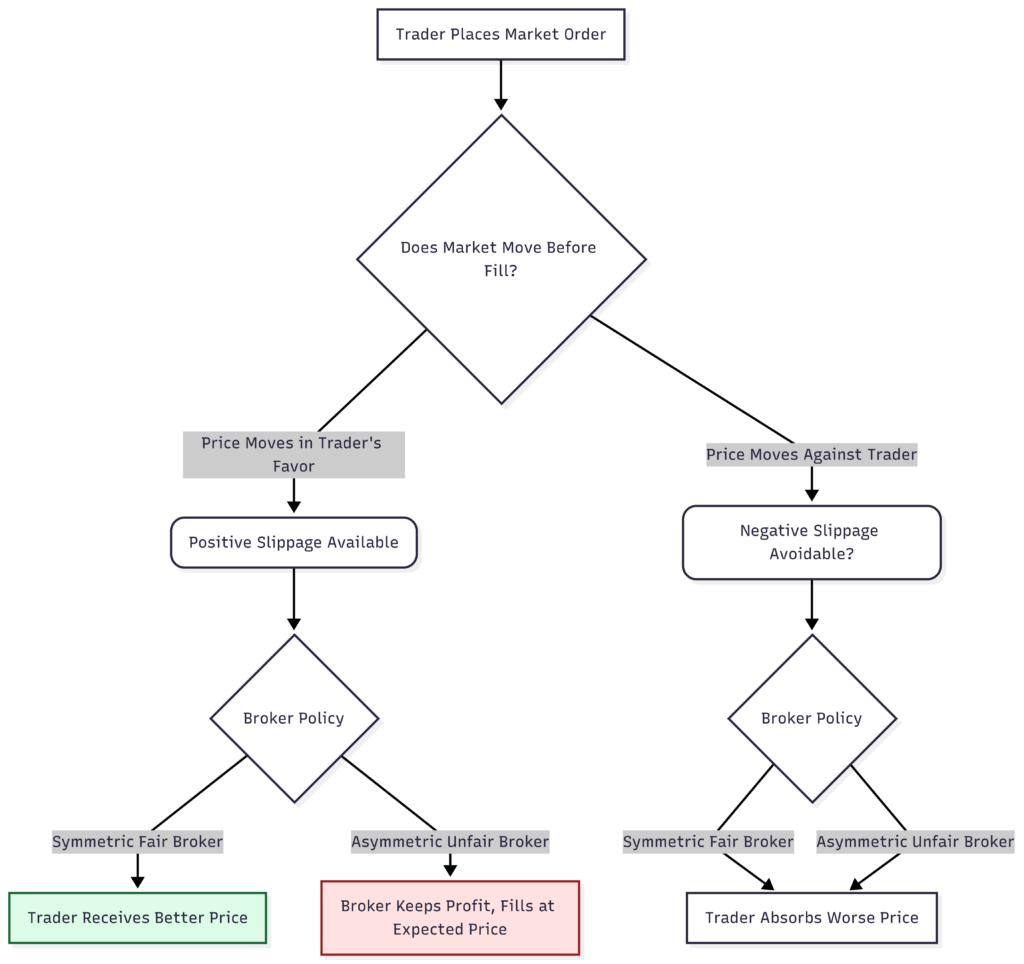
A broker can set rules determining how much price movement is accepted before an order is rejected or requoted. These controls may be needed to manage stale prices and technical errors. It becomes negative for the trader when the rules are applied differently depending on whether the market move helps the broker or the trader, i.e. asymmetrical treatment of slippage.
This distinction matters. The market creates the price movement and this is beyond the broker´s control, but the broker’s system decides how that movement is treated and that is very much under the broker´s control.
Around the world, regulators have taken steps to address unfair execution practices, particularly where brokers do not clearly disclose how slippage is handled. In the United States, the National Futures Association (NFA) has rules and guidance requiring forex dealers to provide fair and transparent execution practices. Firms must not apply execution policies in a way that systematically disadvantages customers, such as accepting unfavourable price movements while failing to provide customers with favourable price improvements when those improvements are available.
In the United Kingdom, the FCA has similar principles, although it is not framed exactly the same way as the NFA rule. The FCA approach is based mainly on best execution, fair treatment of customers, conflicts of interest, and transparency rather than a specific blanket rule about asymmetrical slippage. A key example is the FCA’s 2014 action against FXCM UK. The FCA found that FXCM UK had allowed the group to keep profits from favourable price movements between order placement and execution while passing unfavourable movements on to clients. The FCA described this as asymmetric price slippage and stated that the firm had failed to treat customers fairly and had not correctly applied best execution requirements.
The FCA has also discussed asymmetric slippage in its best execution review. It noted that good practice involved firms not seeking to benefit from price slippage against clients, and specifically described asymmetric slippage as a situation where a firm passes adverse price movements to clients while retaining favourable movements for itself. Notably, the FCA Market Watch 45 also says limit orders should receive the stated price or better where favourable movement is available.
It is important to remember that a fair comparison requires a large sample. Ten orders are not enough to establish a pattern. Traders should examine whether positive and negative slippage both appear over dozens or hundreds of similar transactions. The data should also include rejected orders. A platform may report little negative slippage because it rejects certain price changes instead of filling them. Fill rate, rejection rate, and slippage should be reviewed together.
How Slippage Affects Different Order Types
The risk and form of slippage depend on the order. Here are a few examples of common order types on trading platforms.
Market Order
A market order requests execution at the best available current price. It prioritises getting into or out of the market. Because the final price is not fixed, market orders can receive positive or negative slippage. The risk grows during rapid movement and low liquidity. A trader closing a losing position may reasonably accept some slippage, because completing the exit is more important than waiting for a chosen price that may never return. A trader who really want to open a position can also be willing to accept some slippage, if getting exposure is more important than getting a certain entry price.
Limit Order
For strategies where (negative) slippage is less acceptable, traders typically use limit orders instead of market orders. A limit order sets a worst acceptable price. A buy limit order executes at the limit or lower. A sell limit order executes at the limit or higher.
Limit orders can receive positive slippage, but not negative.
The downside of using a limit order instead of a market order is that your order is more likely to not get filled at all. If the market moves beyond your limit, the order can not execute, unless there is a market reversal and the price moves back within range again. This trade-off is unavoidable. Market orders provide greater execution certainty with price risk. Limit orders provide better price control but with execution risk.
A chart touching the limit does not prove that the order should have executed. The relevant side of the quote must reach the limit and enough liquidity must be available ahead of other orders. For a buy limit, the ask needs to reach the required level. A chart showing only bid prices may create the impression that the price traded through the order, when in reality, the executable ask remained above it. For a sell limit, the bid needs to reach the required level. A chart showing only ask prices may create the impression that the price traded through the order even though the executable bid remained below it.
Stop Loss Order
A standard stop-loss order sets a trigger price. When that price is reached, the order usually becomes a market order (depending on settings and platform policy).
We tend to think about a stop-loss order as something we use to ensure the position is closed automatically at that level, to prevent further loss if the price continues to drop. But in reality, there is nothing “sure” about a stop-loss order. A normal stop-loss does not come with a price guarantee. The position can end up being closed far below the stop-loss level.
Example: A long GBP/USD position has a stop placed at 1.25000. Unexpected news causes the next available bid to appear at 1.24850. The stop is triggered at 1.25000, and it generates a market order, but the position can not be closed until 1.24850, producing 15 pips of negative slippage beyond the planned exit.
This does not mean the platform ignored the stop. It means there was no executable bid at the trigger level when the market order was released.
Stop Limit Order
A stop-limit order becomes a limit order once the stop price is reached. If you don’t want to use a normal stop-loss order (one that converts to a market order when triggered), you can use a stop-limit order instead. It provides more price control than a standard stop-loss, but less certainty of execution. If the market gaps beyond the limit price, or moves through it without trading at it, the order may remain unfilled while the position continues to lose value. The trader avoids an unacceptable execution price but remains exposed to further market risk.
A stop-limit order protects you from negative slippage on execution, because it will not execute at a worse price than your limit. But it does not protect you from the consequences of the market continuing to move against you if the order isn’t filled, and this is important to remember when you are deciding between a normal stop-loss and a stop limit order.
Guaranteed Stop Loss Order (GSLO)
Some brokers offer guaranteed stop-loss orders (GSLOs). With a GSLO, the broker guarantees that the position will be closed at the specified stop price, even if the market gaps beyond it. The broker absorbs the difference. In return for this protection against gap risk, the broker typically charges a premium or additional fee. Think of it as insurance against negative slippage gap risk. You pay a premium in exchange for the safety.
Can Traders Reduce Slippage?
Slippage cannot be completely eliminated when using market execution, but traders can reduce its impact. The choice of trading strategy, order type, market conditions, and execution method all influence how much slippage a trader experiences and how significantly it affects overall performance.
Examples of ways traders reduce slippage:
- Use limit orders when price certainty is more important than execution certainty.
- Avoid trading during major news releases when volatility and spreads can expand.
- Trade more liquid instruments with tighter spreads.
- Use brokers with better execution quality and liquidity providers.
- Reduce order size or split large orders to avoid consuming multiple price levels.
- Use guaranteed stop-loss orders when available and justifiable to avoid adverse stop slippage.
Note: When you backtest a strategy in demo mode, remember that demo mode can be a perfect world where slippage does not exist. Even when true market data is used, it will still not fully reflect live trading if there is zero risk of slippage. Backtesting data should therefore be adjusted to account for realistic slippage before you draw any conclusions.
Execution policy
The broker’s execution policy should be reviewed. It should explain things such as market execution, requotes, price tolerances, positive slippage policy, and stop-order treatment.
Execution model choice
The type of execution model you choose can influence your likelihood of experiencing slippage. Retail brokers generally operate using one of three main execution models: Market Maker (MM), Straight Through Processing (STP), and Electronic Communication Network (ECN). There are also hybrid brokers who incorporate more than one execution model.
Market Maker (MM) Brokers
A Market Maker broker (MM broker) acts as the counterparty to your trade. Instead of sending your order to an external liquidity provider, the broker fills your order internally from its own liquidity. This does not mean that the model is immune to slippage. The broker may be able to provide faster execution because orders are handled internally, but during volatile markets, execution prices may still differ from the price you see when placing the order. The broker controls the environment, and the quality of execution depends heavily on the broker’s pricing and risk management practices. A high-quality Market Maker broker can provide reliable execution, while a poor choice may create wider spreads, more slippage, or more frequent requotes.
STP (Straight Through Processing) Brokers
STP brokers route client orders directly to external liquidity providers, such as banks or larger financial institutions. In a pure STP model, the broker does not take the opposite side of the trades. Execution prices are based on available liquidity in the market, and slippage can occur naturally when prices move between order submission and execution. During normal market conditions, slippage is often smaller because orders are matched with external liquidity. During news events or periods of low liquidity, available prices can change quickly, causing both positive and negative slippage. With STP brokers, slippage is usually a result of market conditions rather than internal dealing.
ECN (Electronic Communication Network) Brokers
ECN brokers provide access to a network where orders are matched with other market participants, including banks, institutions, and other traders.
ECN execution can offer very tight spreads because multiple participants compete to provide liquidity. It is a popular choice among traders who want faster access to available market prices and greater transparency (traders can often see deeper market liquidity).
However, ECN does not eliminate slippage. If liquidity is thin, there may not be enough orders available at the displayed price. Large market orders may be filled across multiple price levels, creating slippage. During high volatility, prices can move before the order reaches the market.
Which Execution Type Has the Least Slippage?
There is no simple answer, and slippage depends on more than the broker model. An ECN broker is not automatically better than an STP broker, and an STP broker is not automatically better than a Market Maker. A well-run broker with strong liquidity relationships can provide better execution than a poorly managed broker using a different model.
Currency pairs
Major currency pairs generally have the highest liquidity, followed by minor pairs. Exotic pairs typically have the lowest liquidity. Higher liquidity usually means tighter spreads, deeper order books, and less slippage. With that said, not every minor pair is more liquid than every exotic pair. For example, USD/MXN is an exotic pair, but it is often more liquid than some minor pairs because Mexico has significant international trade and financial activity.
Session choices
When you elect to trade can have a big impact on slippage. Trading during active sessions usually provides better liquidity than trading during rollover periods, weekends, or holidays. Higher liquidity generally means tighter spreads, more available orders at each price level, and a lower chance of large price deviations between order placement and execution.
Refraining from trading during major news releases can also reduce slippage exposure. Economic announcements, such as interest rate decisions, employment reports, and inflation data, can cause sudden price movements and a rapid reduction in available liquidity. During these periods, spreads may widen, prices can move through multiple levels quickly, and market orders may be filled at a significantly different price from the expected price. Waiting until volatility settles can help traders avoid the increased slippage risk associated with news events.
It should be noted that news does not always create slippage because of volatility alone, it often happens because liquidity disappears when volatility rises. Even if many traders want to buy or sell, there may not be enough counterparties willing to transact at the displayed prices.
Example: Before the news, the EUR/USD ask was 1.10000. After the news release, the price jumps quickly. The available sellers at 1.10000 disappear, and market buy order fills at 1.10020. The slippage is 1.10020 − 1.10000 = 2 pips adverse slippage for the market buy order. Traders using market orders, especially around high-impact events, are more exposed to slippage. Avoiding market orders immediately around scheduled economic announcements can reduce exposure to violent repricing. (Strategies specifically designed to trade news typically come with larger execution allowances.)
Order types
As discussed above, the risk of slippage is impacted by order type. You can reduce the risk of negative slippage by using a limit order instead of a market order, but the limit order comes with its own downsides. Instead of using a standard stop-loss order, you can for instance use a stop-limit or guaranteed stop-loss, but these choices also come with their pros and cons. You can read more about order types and slippage further up in this article.
Position sizing
Position size should ideally reflect available liquidity. For most retail traders, this is less of a concern when trading highly liquid instruments, as individual retail orders are usually too small to affect the market. However, for unusually large retail traders or orders for less liquid markets it can be a concern. You can reduce market impact by splitting large orders into smaller portions. This can help avoid consuming multiple price levels, although it may increase spread and commission costs.
Infrastructure
One of the major causes of slippage is latency. Latency is the time delay between an action taking place and the information or order being processed. In trading, this delay can occur at multiple points. Between the trader and their platform, between the platform and the broker, and between the broker and liquidity providers.
While retail traders cannot control every part of this process, they can control some important pieces of their own trading infrastructure. Better infrastructure does not guarantee better trading results, but reducing unnecessary delays can help traders receive faster execution and potentially reduce avoidable slippage.
When a trader clicks buy or sell, the order does not instantly appear in the market. The request travels through several stages:
- The trader’s computer sends the order.
- The internet connection transfers the data.
- The broker’s trading server receives and processes the order.
- The broker routes the order to liquidity providers or executes it internally.
- A confirmation is returned to the trader.
During this time, prices can move, and in fast-moving markets, especially during news events, even a small delay can mean the requested price is no longer available.
For example, a trader may click to buy EUR/USD at 1.08500. If the order takes additional milliseconds to reach the broker and the market moves higher during that time, the trader may receive an entry at 1.08505 or 1.08510 instead.
The difference may appear small, but for active traders, scalpers, and high-frequency strategies, repeated small amounts of slippage can become a significant cost.
Execution Latency vs. Slippage Risk Simulator
Simulate how connection ping and market volatility combine to drive expected slippage during high-impact trading windows.
Retail traders can reduce latency by improving their own infrastructure
Retail traders cannot replicate the infrastructure of large financial institutions, but they can avoid creating unnecessary delays on their own side.
- Use a fast and reliable computer
When the trading platform runs on the trader’s computer, and an overloaded system can create significant delays. A computer struggling with too many applications, insufficient memory, outdated hardware, or background processes may respond slower. A computer with enough available processing power and memory can help ensure the trading platform responds quicker. The goal is not to buy the most expensive computer available. The goal is to have a system that can handle the trader’s platform, charts, indicators, and other tools without becoming a bottleneck.
For a web browser trading platform, most of the heavy processing (e.g. market data handling, order routing, and execution logic) takes place on the broker’s servers. This means that your computer´s performance becomes less of a concern. But your computer still needs to be powerful enough to run the browser smoothly, while also rendering charts and the user interface. It needs to maintain a stable connection to the internet and send your order instructions quickly. Still, the impact is usually smaller than with a desktop trading platform, such as a downloaded version of MetaTrader, cTrader, or broker-specific software.
Even a powerful computer can become slow if it is overloaded, and an overloaded computer can create delays for a trader in various ways. Therefore, it is a good idea to remove any unnecessary background applications that may consume CPU, RAM, or network bandwidth before you start trading. Low RAM can for instance cause the browser to lag or froze.
Even if you close down everything that is not trading related, your computer might still struggle if it is not sufficiently powerful. Traders often run multiple trading platforms, dozens of charts, automated indicators, browsers, video streams, and other applications simultaneously. Every additional process consumes system resources, and a cleaner setup can improve reliability and speed. Close unnecessary trading programs, reduce the number of charts, and avoid running demanding applications in the background.
Keep the operating system and trading software updated, and do not ask more from your computer than what it can comfortably handle. A simple, stable setup is often better than a complicated setup.
- Use a cable connection instead of Wi-Fi
For serious trading, a wired Ethernet connection is usually preferable to Wi-Fi. Wi-Fi can introduce additional uncertainty because of signal interference, congestion, distance from the router, and connection fluctuations. A cable connection provides a more stable link between the trading computer and the router. The difference may not matter for every trader, especially those holding positions for days or weeks, but it can matter more for short-term traders who depend on precise execution.
- The Ethernet cable and the router
The Ethernet cable and router can affect trading latency because they are part of the connection path between your computer and your broker’s trading servers.
A weak or damaged Ethernet cable can cause connection instability, slower speeds, or packet errors that require data to be retransmitted, adding delays. However, for most retail traders, the difference between standard modern Ethernet cables is minimal. There is usually no need to invest in some type of very fancy Ethernet cable; just make sure that the one you use is in good condition.
The router plays a role because it manages the traffic between your computer and the internet. An older or overloaded router may add small delays when processing network traffic. However, investing in a very expensive router is usually not needed. Just as with the cable, you can use a standard router as long as it is kept in good condition.
Another issue is called bufferbloat, where a router allows large amounts of data to build up in its queues. For example, if someone on the same network is downloading large files, streaming video, or gaming, trading data may have to wait behind that traffic, increasing latency. This is not really a router problem; it is a household problem that you will need to resolve by communicating with the other persons who use the same network.
- Use a fast and stable internet connection
Use a fast and stable internet connection. A trader’s internet connection is one of the most important parts of their infrastructure. A fast connection helps, but stability is equally important.
A connection that occasionally drops, experiences interruptions, or has inconsistent performance can be more damaging than a slightly slower but reliable connection.
For trading, the list of important factors include low latency, low packet loss, consistent performance, and reliable uptime. The fastest advertised internet package does not always provide the best trading experience. A trader should evaluate the quality of a connection based on real performance (both up and down) rather than the advertised download speed. A 1 gigabit connection is not automatically better for trading than a lower-speed connection if the 1 gigabite has poor routing or unstable performance.
Two traders in the same city may have significantly different experiences depending on their respective ISP’s network quality and routing.
Strong ISP customer support is another aspect to take into account. You don´t want to be cut off from trading for days because of some snafu in the billing department that takes ages for the support to sort out.
- Consider transitioning from smartphone trading to desktop trading
Many retail traders in Kenya now place trades using smartphones and tablets. While mobile trading platforms are convenient and have become increasingly sophisticated, mobile trading can introduce additional sources of latency compared with trading from a desktop or laptop computer.
One factor is the internet connection. Smartphones often rely on mobile data or Wi-Fi, both of which can be less stable than a wired Ethernet connection. Mobile networks are affected by signal strength, network congestion, and the user’s location, causing latency to fluctuate throughout the day. Similarly, Wi-Fi connections can experience interference from other devices, physical obstacles, or competing wireless networks. (Side note: If your desktop or laptop uses Wi-Fi within your home, switching to a wired connection can be a good idea.)
Smartphones also have less processing power than most modern desktop computers. Although today’s mobile devices are capable of running trading apps smoothly under normal conditions, they are generally not designed for the same level of sustained performance as a dedicated trading workstation. Background applications, operating system updates, battery-saving features, and limited system resources can all contribute to small delays in processing market data or transmitting orders.
Another consideration is the user interface. Entering an order on a small touchscreen can be more difficult and more prone to input errors than using a keyboard and mouse. During fast-moving markets, these extra moments can be more significant than the technical latency of the device itself.
This does not mean traders should avoid mobile trading altogether. Smartphones are excellent for monitoring open positions, receiving price alerts, checking market conditions, and managing trades while away from a desk. However, traders who depend on precise execution (such as scalpers or those trading around major economic announcements) may achieve more consistent performance by placing orders from a desktop or laptop computer connected to a stable wired internet connection. If this is not a feasible solution for you, and latency has become a problem, you could consider switching to a strategy that is less sensitive to latency. For swing traders and long-term investors, the difference in latency between a smartphone and a desktop computer is unlikely to have a major impact on overall trading performance. As with other infrastructure decisions, the importance of the trading device depends largely on the trader’s strategy and execution requirements.
There is no definitive industry-wide statistic covering all Kenyan retail traders, but multiple recent industry reports consistently describe Kenya as a mobile-first forex market, driven by high smartphone penetration, widespread mobile internet access. However, it’s useful to distinguish between accessing the market and higher-level trading. Novice and very small-scale retail traders are more likely to use a smartphone as their primary trading device because smartphones are affordable, portable, and sufficient for monitoring markets and placing trades. More experienced retail traders in Kenya, particularly those performing detailed technical analysis, backtesting strategies, or running Expert Advisors (EAs), are more likely to use desktop or laptop computers, and benefit from larger screens, keyboard and mouse controls, greater computing power, and the possibility of using multiple monitors simultaneously. In Kenya, many retail traders transition to desktop or laptop computers as they gain more experience, becomes more profitable, and start trading larger positions. While smartphones offer excellent convenience, non-mobile setups generally provide a more stable and efficient trading environment, especially for trading strategies that are sensitive to latency and execution quality.
- VPS hosting
A Virtual Private Server (VPS) is a remote computer hosted in a professional data centre. Instead of running a trading platform on a personal computer at home, the trader runs it on a server that stays online continuously. You can read more about VPS further down in this article.
Understanding how institutional traders reduce latency
When discussing latency and slippage, it can be helpful to understand how large financial institutions, such as investment banks, proprietary trading firms, hedge funds, and high-frequency trading firms, reduce latency in their own trading operations. These institutions operate on a completely different level from retail traders and invest heavily in technology, infrastructure, and connectivity to improve execution speed. When executing huge volumes, even a tiny advantage can hold significant financial value.
One major advantage institutions have is server location. Institutional traders often place their servers physically close to major liquidity providers, exchanges, and trading venues. This practice is commonly known as colocation. The shorter the physical distance between the trading server and the market infrastructure, the less time it takes for information and orders to travel. A server located in the same data center as a liquidity provider in London can communicate much faster than a trader operating from a home computer in Nairobi. For institutional firms engaged in very fast strategies, reducing latency by milliseconds can be highly valuable.
Kenya is not home to any of the major liquidity providers and trading venues involved in the global forex trade. Instead, these participants are found in forex hubs such as London, New York, Tokyo, and Singapore. The largest forex liquidity providers include global banks such as JPMorgan Chase, UBS, Citigroup, Deutsche Bank, and Barclays, and their electronic trading infrastructure is concentrated in major financial data centres. Much of the institutional FX market operates through data centres such as Equinix LD4 in London, Equinix NY4 in New York, and Equinix TY3 in Tokyo. These facilities host banks, prime brokers, ECNs, and other market participants so that orders can be transmitted with extremely low latency.
While Kenya does have an exchange for securities, it is not a major FX trading hub, and international retail forex brokers generally do not host their trading servers in the country. If you are trading forex from Kenya, your order will typically travel over the internet to your broker’s server, which is much more likely to be located in London, Amsterdam, Frankfurt, or another major financial centre, before being routed to liquidity providers.
How retail traders in Kenya can benefit from VPS hosting
Retail traders cannot usually place their own servers inside institutional data centres, but they can use a Virtual Private Server (VPS) to reduce latency. A VPS is a remote computer hosted in a professional data centre. Instead of running a trading platform on a personal computer at home, the trader runs it on a server that stays online continuously, and the server can (usually) be placed closer to broker´s trading server.
A home computer can be more prone to experience power outages, overloading, mandatory restarts, internet interruptions, sudden software updates, and accidental shutdowns. VPS is designed to remain online continuously or only be taken down for pre-programmed maintenance. This increased reliability can be especially useful for traders running automated strategies (trading bots).
As mentioned above, it can also be possible to use a VPS that is closer to your broker´s server. If the VPS provider’s server is geographically close to the broker’s trading server, communication between the trader’s platform and broker can become faster. The exact benefit depends on several factors, including the actual locations involved.
Note: Using a VPS is not automatically better than using a home computer, and a poorly located VPS, unreliable provider, or incorrect setup can even make things worse.
Can retail traders in Kenya use VPS services?
Yes, retail forex traders in Kenya can access VPS services.
There are three common options:
- Broker-provided VPS
Many brokers either recommend third-party VPS providers or offer VPS hosting to eligible clients. Some forex brokers offer free or discounted VPS hosting if you meet certain requirements, such as maintaining a minimum account balance or trading a specified monthly volume. This is often the simplest option because the VPS is typically configured to connect efficiently to the broker’s trading servers. - Independent VPS providers
Kenyan traders can rent a VPS from international providers with data centres in major financial hubs such as London, Amsterdam, Frankfurt, or New York. If your broker’s trading servers are located in one of these cities, choosing a VPS in the same or a nearby data centre can help reduce latency. - Cloud computing services
Some traders in Kenya use virtual machines from large cloud providers. While these can work well, they are often more complex to set up than a VPS designed specifically for forex trading.
The goal is not to have the VPS physically close to you, it is to have it close to your broker’s trading server. For example, if your broker’s servers are in London, a London-based VPS will generally provide lower latency than a VPS in Nairobi. You then connect remotely from Kenya to the VPS. Even if your connection to the VPS has higher latency, the critical communication (i.e. between the VPS and the broker) will be much faster. Although your remote connection from Kenya to the London VPS may have a latency of around 100–200 milliseconds, the VPS can communicate with the broker’s server in just a few milliseconds if they are in the same city or data centre. This is the part of the communication path that matters most for order execution.
Is a VPS worth it?
If a VPS is worth it or not will largely depend on trading style. A VPS is a common choice among traders who are running automated trading systems (e.g. Expert Advisors) around the clock, traders who engage in scalping or similar strategies where execution speed is extra important. Traders who experience unreliable electricity, internet or computer access at home can also benefit.
A VPS may provide less benefit if you trade manually, hold positions for days or weeks instead of doing daytrading, and aren´t particularly sensitive to small execution delays.
For many retail traders in Kenya, a VPS is best viewed as a tool for improving reliability and potentially reducing latency, not as a way to gain a guaranteed trading advantage. Whether it’s worthwhile depends on the strategy being used and the cost relative to the expected benefit.
Common Slippage Misconceptions
- Common misconception: Slippage only occur with poor-quality brokers
Slippage is not limited to poor-quality brokers. Even with well-regulated and reputable forex brokers, slippage can occur because prices and available liquidity change continuously. During periods of high volatility, low liquidity, or rapid price movements, the requested price may no longer be available by the time the order reaches the market. While a broker’s quality can influence how often and how severely slippage occurs, no broker eliminates slippage entirely, unless they decide to eat the cost of negative slippage themselves.
- Common misconception: All slippage is negative for the trader
There is both negative slippage and positive slippage. If you trade with a broker where you only experience negative slippage, that is cause for concern.
- Common misconception: A widening spread is the same as slippage
A widening spread is not the same as slippage. Spread expansion changes the quoted bid and ask before execution. Slippage changes the final fill relative to the expected executable quote.
- Common misconception: A zero-slippage broker is the best choice
Claims of “zero slippage” should be read carefully. They may apply only to certain order sizes, instruments, or market conditions. If the policy states that zero slippage is only guaranteed under “normal market conditions”, you can expect to experience slippage when there is a stormy event and the market gaps. When you need it the most, the protection will not be there. A broker that advertises zero slippage is not automatically better than other brokers.
- Common misconception: Retail traders can and should eliminate slippage completely by investing heavily in trading infrastructure
Infrastructure is an investment with trade-offs. Improving trading infrastructure can help reduce unnecessary latency, but traders should view it as a cost-benefit decision. Not every trader needs expensive hardware, premium internet service, or a VPS. The value of infrastructure depends heavily on trading style. And no matter how much you invest, you will not be able to completely eliminate slippage, since so many other factors are involved.
The goal for retail traders should be efficiency, not unnecessary spending. A sensible approach is to ensure the trading computer is reliable and keeping the system clean and free from unnecessary workload. Use a stable wired internet connection and choose a reliable ISP. Consider a VPS if trading style and broker location justify it. For some traders, these improvements may noticeably reduce execution issues. For others, the difference may be too small to justify the cost. The correct infrastructure depends on factors such as the trader’s strategy, trading frequency, account size, and sensitivity to execution. Reducing latency can help reduce avoidable slippage, but the best investment is the one that improves trading performance relative to its cost.
Slippage FAQ
Is Slippage Normal In Forex Trading?
Yes. Slippage can occur whenever the market price changes between order submission and execution. It is more common during volatile conditions, low-liquidity periods, and for large orders, but small price differences can also occur during routine trading conditions.
Can A Broker Prevent Slippage?
A broker can reduce delays, use stronger liquidity connections, and apply price controls, but it cannot guarantee that liquidity will remain available at the displayed price. A guarantee requires the broker to absorb the difference when the market moves. When such guarantees are offered, it is typically for an additional cost, and sometimes also under restricted conditions.
Does Slippage Mean A Broker Is Manipulating Prices?
No. One adverse fill during a fast market is not evidence of manipulation. Concerns are more reasonable where negative slippage is frequent but positive slippage never or hardly ever appears, especially if the stated policy does not explain the discrepancy.
Is Positive Slippage A Broker Error?
No. Positive slippage occurs when the market moves to a better price before the order is completed.
Is Slippage And Spread The Same Thing?
No, slippage is not the same as the spread. The spread is the difference between the current bid and ask. Slippage is the difference between the expected execution price and the actual fill. A trader can pay both costs in the same transaction. A buy order begins at the ask, which already includes the spread, and may then be filled above that ask because the market moved before execution.
How Much Slippage Is Acceptable?
There is no universal rule for acceptable slippage. It depends on factors such as the currency pair being traded, order size, market liquidity, trading session, volatility, and the trading strategy itself.
For example, a swing trader targeting a 100-pip move may not be concerned about one pip of slippage because it has little impact on the overall trade. In contrast, a scalper targeting only two pips of profit will find that an average slippage of just 0.25 pips significantly reduces profitability.
In some cases, it is the slippage and the transaction costs combined that eliminate the strategy’s expected edge, and slippage can therefore not be evaluated in isolation.
Rather than asking whether a certain amount of slippage is acceptable in general, traders should ask whether it is acceptable for their strategy. The smaller the expected profit per trade, the more important it becomes to minimise slippage and other trading costs that erode that small per-trade profit.
This article was last updated on: August 3, 2026