

Identity theft online is not only about someone opening a mobile loan in your name. In the trading space, scammers can steal something even more valuable: the years of trust built by a real, reputable and properly regulated broker. They then bolt that stolen brand onto a fake site and use it to receive deposits and personal information (including identity verification documents).
In Kenya, the Central Market Authority (CMA) and the Central Bank have both issued public alerts warning traders about scammers who piggy–back on the names of legitimate firms to look safe at first glance.
In this article, we will take a closer look at the so-called broker clones, and how to avoid them.
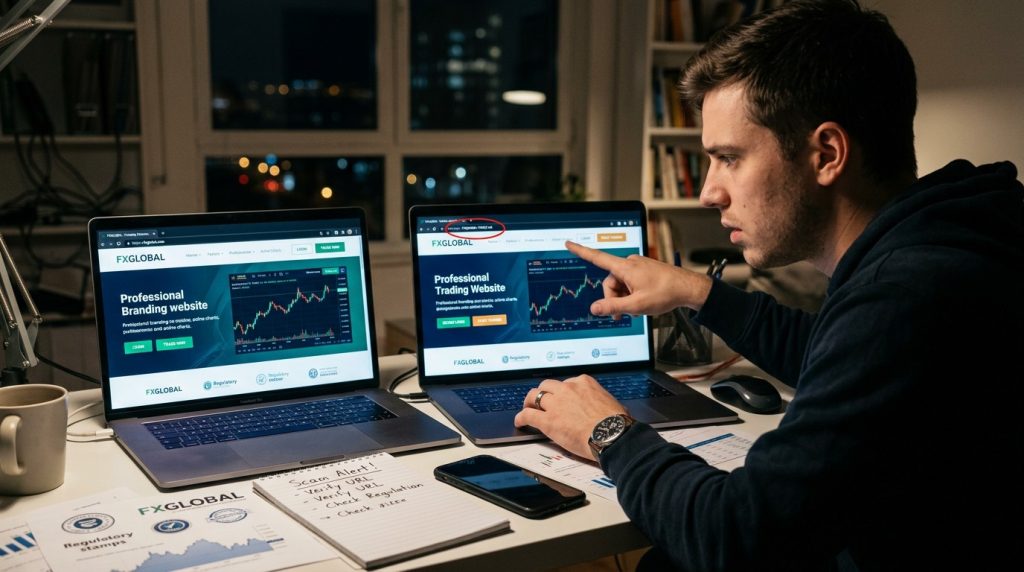
The Clone Broker Scam
In the context of online brokers, a clone is scammer that copies the identity of a real brokerage to make traders believe they are serious and trustworthy. Traders who would never send their money and personal information to a an offshore broker with no operational history will often trust the clone of a well-known, reputable and properly licensed brokerage.
Clone-scammers can steal pretty much everything from the legitimate web site of the brokerage they intend to impersonate, including things such as the logo, colors, brand name, and “About Us” text. The web site can look identical or almost identical. In some cases, even the registration number on the page belongs to the real company.
Typically, the domain name is sufficiently similar to avoid suspicion.
Fictional examples:
- ABCBroker.sc instead of ABCBroker.ke or ABCBroker.com.
- ABCBrokerKenya.com instead of ABCBroker.com.
- ABCBrokerGlobal.com instead of ABCBroker.com.
- ABC-Broker.com instead of ABCBroker.com.
What complicates the situation is that many reputable multinational brokerage companies do operate through several domain names, e.g. to differentiate between different geographical markets and compliance frameworks.
Examples of other common differences:
- Information about how to deposit can be different, since the scammer want you to deposit your money to their account and not to the real brokerage company.
- The list of available deposit methods can be shorter or different.
- The contact information can be different, since the scammer does not want you to get in touch with the real broker.
- The scammer can advertise special promotions, such as a huge time-limited welcome bonus, enormous leverage, or free perks for new signups. Since they have no plans to honor their obligations, they can promise you the moon simply to get you to sign up and deposit quickly.
In Kenya, a common clone type is the one that pretends to be a CMA regulated online forex broker, or pretends to have “CMA partnership” status. The goal is simple: get you to believe the broker is CMA supervised and make you feel safe enough to deposit into an account the scammer controls, usually via cards, mobile money or crypto, before you notice someting is off.
On the surface it looks like a normal onboarding flow. Underneath, there is no legal relationship between you and the genuine firm at all.
The “Intermediary Platform” Scam
The “Intermediary Platform” scam is a new version of the clone website scam. This scam involves “Robo-Advisors” or “Signal Apps” that claim to be “CMA Partners.” The CMA recently moved to license these Intermediary Service Platform Providers in an attempt to prevent these scams. If an app claims to be a partner but isn’t on the CMA Intermediary Service Platform Provider list, it’s likely a clone trap.
Clone VS Real Comparison Table
A quick overview of what you should be vary of to avoid getting fooled by a clone website.
| Feature | Genuine CMA Broker | Clone/Scam Broker |
| Domain | Exactly as listed on cma.or.ke | Hyphens, extra letters, or .net/.sc |
| Promises | Risks are clearly stated; no guarantees | “Guaranteed 30%,” “No-risk,” “Turn life around” |
| Deposits | Official bank accounts or M-Pesa Till | Personal M-Pesa numbers or Crypto only |
| Sales Style | Professional and patient | High-pressure; “Only 5 slots left!” |
Why Clones Work So Well
Clones are effective because they combine three things you see every day:
- Familiar branding
- Real regulatory language
- Emotional pressure to act fast
The branding makes the brain relax. You recognize the logo or name, maybe from a genuine advert campaign or from the CMA licensee list, and your guard drops a bit. Maybe one of your friends or colleges are using the genuine firm and speaks warmly about them.
The regulatory language helps too. Scammers copy disclosure text, risk warnings and legal boilerplate straight from the real site. That makes everything feel “official” and serious.
Then the emotional pressure starts. Messages about “guaranteed returns”, “locked in daily profits” or “special offers” are used to pull you into a quick decision and skip the time-consuming checks.
Once you understand that mix, you start to see why the small details, such as exact domain name, contact info, and deposit information, matter more than the logo at the top of the page.
The Domain Mismatch
As mentioned above, scammers typically pick a domain name that they think will seem legit. They can for instance add a tiny change to the genuine address, such as a hyphen or extra letter. ABCBroker.com becomes ABCBrokers.com or ABC-Broker.com. Another popular methos is to use a different top level domain (for example .net or .online) instead of the real broker’s .com or .ke. It is also possible to put the real broker’s name in a subdomain like ABCBroker.kenyantrading.com rather than in the main domain.
Domain control is the heart of the whole operation. This is why CMA licensees are listed with their specific website or websites on the CMA portal. Any other domains that claim to be that firm, but are not listed there, should be treated as suspect. Either stay away all together, or contact the genuin firm through the contact channel listed on the official site (the one registered with the CMA) to ask for a clarification.
Always Verify Directly With the CMA
Any scammer can claim to be CMA licensed. They are lying liars who lie, so there is no need for them to go out and get an actual license from the CMA or any other financial authority – not even one of the lax ones.
Because of this, you should always confirm any claims directly with the applicable financial authority.
To check an alleged CMA licensed broker, do this:
- Go to the CMA licensee database at https://licensees.cma.or.ke. Alternatively, go to cma.or.ke and click your way to the licensee database.
- Search for the broker’s name in the relevant category (for example “Non-dealing Online Foreign Exchange Broker”)
- Check the website address shown there against the one you are about to use.
Scammers rely on you not doing that check, or not noticing the small differences.
- Additional Information About Verifying a CMA-licensed Broker
- When you are about to verify a broker, it is very important to go directly to cma.or.ke or licensees.cma.or.ke. Do not use any links provided by the broker.
- For the licensee entry at the CMA site, you will usually see the registered address (which can be a PO box), the license number, and the official website. You can use the official website to find the true contact channels, in case there is something you wish to ask the genuine brokerage firm. Do not rely on any contact channel on the suspicious page or anywhere else outside the CMA registered website, e.g. in a trader forum online or in a trader WhatsApp/Telegram group.
- If the web site you are interested in do not match the CMA- registered web site, you can either stop right now and not proceed, or you can contact the genuine firm through the correct channels. “This site is not registered with the CMA, is it still yours, and will I be covered by the CMA license if a sign up through it?”
The “Urgency” Script: How Clones Push You To Deposit Quickly
Clones do not want to you take your sweet time thinking this true, reading every letter of their domain name, verify with the CMA, and so on. They want you to act right now, before you notice that something is off. A second hallmark of clone operations is therefore how they communicate with potential sign-ups. They tend to employ high-pressure sales tactics, and they can promise you the world since they neither have to be CMA compliant nor actually fulfill those promises.
Genuine, regulated brokers tend to be more boring. They might be running promotions, but there is a limit to how aggressive they can be without upsetting the CMA. They do not promise fixed returns or any other guaranteed profits.
While it is true that campaigns tend to be time limited even with reputable brokers, be aware of the high-pressure sales tactics employed by scammers who need you to sign up and deposit RIGHT NOW. The combination of stress, downplaying risk and/or hinting at unreasonable returns is a big red flag.
- “We have a guaranteed trade signal running now, you must deposit today to benefit. Risk free!!!!”
- “Clients who joined yesterday already made 30%, don’t miss your slot. Only FIVE left!”
- “This is a one time opportunity, the offer closes in two hours. This is your once chance to turn your life around within 30 days.”
What To Do If You Suspect You Might Have Fallen For a Clone
Sometimes we only realize something is wrong after we have already sent money and/or shared documents. How you act when you start feeling suspicious is very important. You might not be able to get your deposit back, but you can stop the bleeding.
If you suspect you are dealing with a clone or other scammer, a few immediate actions matter more than angry emails to the scammer.
- Stop sending funds immediately. This might sound like a no-brainier, but it can actually be quite difficult. The sunken cost fallacy makes us reluctant to just cut our losses and leave. We want to believe that there is some way to recover and fix the problem. Do not try to get your money back by following more instructions from the same people, even if they claim they can recover your losses for a fee, or that you account will be restored if you just make another small deposit “to verify your deposit method”.
- Check your pride. When we detect a potential scammer before making a deposit, we fell smart and proud. When we detect a potential scammer after making a deposit, we feel foolish and ashamed. We don´t want it to be true, and this can make us ignore the early warning signs.
- Immediately inform your bank, card provider, payment processor, etcetera. Ask about chargebacks or dispute options, and clearly state that you believe the recipient is a fraudulent broker operating as a clone and soliciting deposits in Kenya.
- File a report with the CMA. You can contact the CMA through its official channels listed on https://www.cma.or.ke/.
- Consider filing a report with the Central Bank and/or the Kenyan police as well.
- Share the information with other traders in a factual way. One calm, detailed post about a clone domain and how it behaved can help someone else avoid the same trap. A long and rambling emotional post filled with expletives is easier to ignore.
- Learn about recovery scams and how to avoid them. More information is available further down in this article.
- Learn about identity theft associated with fraudulent brokers and how to protect yourself. This is especially important if you have gone through the identity verification process and KYC with the fake broker, and send them copies of your ID card, passport, utility bills, etcetera.
The Kenyan Police
In Kenya, fraud investigations responsibilities fall largely under specialised units of the Directorate of Criminal Investigations (DCI), which is part of the National Police Service. The DCI includes several specialised units that investigate types of fraud and related financial crimes, including the Cybercrime and Digital Fraud Sub-Units which, under the Investigations Bureau and Serious Crime sections, tackle online fraud, cybercrime, and identity theft. The Cybercrime Unit is located at Mazingira House on Kiambu Road. They also operate a toll-free tip line at 0800 722 203.
However, when scammers are operating from abroad, it can be difficult for the Kenyan legal system to act in a meaningful way to recover funds and bring fraudsters to justice. This is yet another reason why Kenyan traders are recommended to stick to CMA licensed brokers with a Kenyan presence, even though they can easily access foreign brokers online.
CMA “Whistleblower” Incentive
The CMA operates a Whistleblower Regulation that rewards people who report wrongdoing. If someone provides “new and timely” information that leads to recovered funds, they can receive a reward of up to 3% of the recovered amount, capped at 5 million KES.
That creates an extra incentive for the public—especially traders—to report clone firms or suspicious operators, since exposing fraud can both protect others and potentially earn a financial reward.
Clone Scams Followed by Recovery Scams
Broker clone scams and recovery scams often happen in sequence, targeting the same victim twice. If you lose money to a clone scam, the fraudster now sits on a lot of useful information about you, including your full name, contact info, and exact amount lost, when, and to which clone site. The fraudsters can now use this information for a recovery scam, or sell it on to another fraudster.
A recovery scam typically work like this:
After falling victim to the clone scam, the victim is contacted by someone claiming they can recover the lost funds. Typical impersonations include the national police (in Kenya or elsewhere), Interpol, a financial authority (CMA or a foreign one), law firms, or blockchain recovery specialists (if the victim deposited cryptocurrency). Some claim to be private investigators with useful but discrete connections to well-known authorities such as the FBI or Europol.
While promising to recover the funds, the fraudster requests a payment, e.g. a legal processing fee, a tax payment, or an investigation fee. When cryptocurrency is involved, asking for a blockchain tracing fee is common.
After payment, no recovery happens. In some cases, the fraudster will continue to ask for more money, using various justifications and pressure points, until the victim has been bled dry.
Recovery scammers can be very convincing, since they already have so much information about the victim, including how much money that was lost in the first scam and to which site. During initial contact, victims often inadvertently help the fraudsters along further by volunteering additional information, e.g. by mentioning a CMA or police report, or the bank involved, which the fraudsters can then include in their pitch to make it even more believable.
Do not engage with people who offer to recover you lost funds for a fee.
IOSCO´s I-SCAN International Alerts Portal
IOSCO’s I-SCAN alerts portal at https://www.iosco.org/i-scan/ aggregates warnings from regulators across different countries, including alerts about clone firms and unauthorized online brokers.
IOSCO stands for the International Organization of Securities Commissions. Headquartered in Madrid, Spain, it is a global cooperative of securities regulators. Founded in 1983, IOSCO’s members now regulate over 95% of the world’s securities markets.
More information about clone-scams
The UK FCA maintains detailed clone warnings that are worth reading even if you trade from Kenya, because the underlying tricks are the same across the globe.
https://www.fca.org.uk/consumers/clone-firms-individuals
This article was last updated on: March 10, 2026