

The popularity of online retail forex trading has unfortunately also made it a popular lure for scammers who want to steal money and personal data from unsuspecting individuals. Many different forex scams are circulating, both in Kenya and elsewhere. Some are more specific to the world of forex trading (e.g. forex signal service scams), while others are well-known traditional scams that have been given a touch of forex as bait, e.g. the classic romance-investment scam which has been repackaged to focus on forex instead of other types of investments.
Below, we will take a look at a few examples of different types of scams that forex traders should be aware of, and some information about how you can reduce the risk of being scammed.
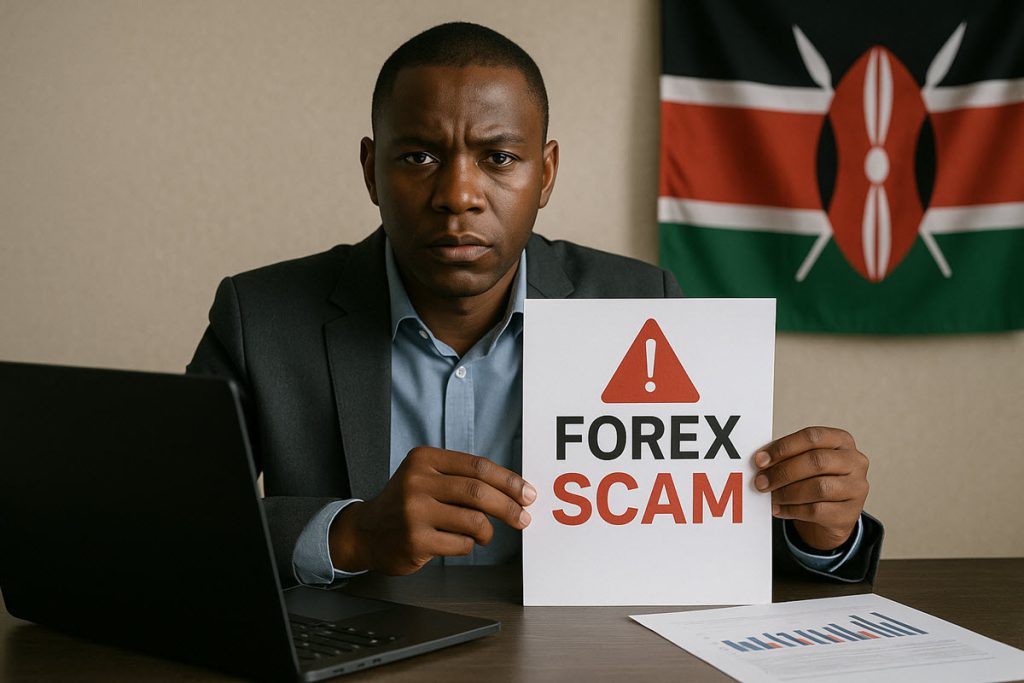
Examples of Common Scams
Fraudsters that clone broker sites
Cloned versions of real, licensed brokerage firms can trick you into depositing money and sharing private information (which can be used for identity theft). Cloned domains or pages impersonating real, licensed brokers. The site looks right, but a few details are off.
Examples:
- The official broker url is Brokername.com, while the fake site is Brokername.int. You think you have come to the international version of the broker´s site, but it is just a fake clone.
- The official broker url is Brokername.com, and the fake site is Brokename.com.
- The payment information is different, since the fraudsters want you to deposit money into their account.
- The customer support contact information is different, because the fraudsters do not want you contact the true support department and find out the cloned site is a fraud. Sometimes the fraudsters put in the effort to provide contact information that they claim is specifically for “forex traders in Eastern Africa”, “forex traders in Kenya”, or “forex traders outside Europe”, and their lies can be really convincing.
Always navigate to a broker’s site from the CMA register entry and confirm funding details inside the client portal before paying.
Signal service fraudsters and low-quality providers
There are a lot of signal service providers targeting the Kenyan market, and many of them are either outright fraudsters or simply really low-quality. From a legal perspective, it can be difficult to draw the line between an outright fraud and a signal service provider that is selling signals of very low quality. Either way, forex traders lose their money: both the money they paid for the service and the money they risked on the trades recommended by the signals.
Some signal service providers get paid to funnel you to a specific broker site, and they will be very eager to make you click on their referral link since they get a kick-back from the broker. Always do your own research before you sign up with any broker. Do not trust any claims of “guaranteed profits” spouted by a signal service provider.
There are also fraudsters who use a purported signal service to convince you to share your trading account log in credentials. This way, they can take control of your trading account and empty it.
Account Management Scams
Be aware of the account management scams where you are encouraged to allow someone else to trade on your behalf. If you share your log in credentials with one of these “trading experts”, expect your account to be cleaned out, either through transfers or through a series of losing trades.
Some account management scams are not looking to get their hands on your existing trading account. Instead, they will insist your open a new account with another broker, one that is not licensed by the Capital Markets Authority (CMA) of Kenya. If the service insists you open an account with a specific broker/platform, that’s a big red flag.
Payment traps for Kenyan traders
Examples of common transfer scams:
- Doing a SIM-swap or account-takeover of your phone, and then initiating withdrawals away from you.
- Hijacked paybills and tills. If you make deposits outside the broker´s official portal, you are probably sending them to a fraudster.
Unlicensed and poorly licensed brokers
Using unlicensed brokers or brokers licensed in countries with weak trader protection rules can work out if you are really lucky, but it is definitely high-risk. By picking this type of broker, you are increasing the risk of being scammed.
Some of these brokers are really good at taking your money in discrete ways that are difficult to prove. They can for instance manipulate the price feeds within the trading platform, to ensure that you lose money. You will not lose very trade, of course, since this would make you suspicious and make you give up on trading. These brokers want you to continue to trade and make new deposits, while they quietly fleece you.
- When you pick a broker licensed outside Kenya, you introduce jurisdictional complexity, and you might end up in a situation where neither jurisdiction can give you full protection.
- When you pick a broker licensed in a relaxed jurisdiction, such as an offshore paradise island, you will not get the same trader protection rules as enforced by the Kenyan CMA.
- When you pick an unlicensed broker, you have even less recourse if something happens, and the risk of losing all your money is very high.
How to Reduce the Risk of Getting Scammed
Stay away from unlicensed and poorly licensed forex brokers
To ensure their broker is licensed and supervised, while also avoiding jurisdictional complexity, forex traders in Kenya should ideally pick a broker that is licensed by Kenya´s Capital Markets Authority (CMA). CMA and the Central Bank of Kenya (CBK) have repeated this advice in official public notices and social media posts for years, due to the many cases of Kenyan traders ending up being scammed by unlicensed brokers and brokers licensed in lax jurisdictions far away. CMA and CBK have issued both joint and separate cautions against unlicensed online forex platforms and “investment” schemes that pretend to do FX. The pattern is familiar: guaranteed returns, downplaying risk, WhatsApp or Telegram pitches, requests to send money to personal numbers or to “agents,” and vague or fraudulent paperwork. When issues grow and are reported to the Kenyan authorities, victims discover the entity was never licensed at all or was licensed by a lax financial authority in a country that does not care about Kenyan traders being scammed.
The language from the Kenyan authorities stays consistent: pick a CMA-licensed broker, verify the license on the official CMA website, and do not deal with other brokers and platforms.
Always verify the license directly with the CMA
CMA maintains a list of licensed entities on their official site: https://licensees.cma.or.ke/licenses/5/.
This list is updated continuously, so you need to visit the site yourself to obtain current information.
At the time of writing (December 2025), the CMA list includes brokers such as EGM Securities (FXPesa), SCFM (Scope Markets), Pepperstone Markets Kenya, Exinity Capital East Africa, HFM Investments (HF Markets), Windsor Markets Kenya, Exness KE, Ingot KE, Admirals KE, FP Markets Limited (Kenya), IC Markets (KE) Limited, Trademax Global Markets (KE) Pty Limited, and TPXMGLOBAL Kenya Limited.
Examples of Red Flags
- A broker’s name is not included in the CMA register.
- The name shown in the register doesn’t match the website, legal entity, or bank details you are given.
- The broker had a license in the past, but it is no longer active.
- A broker´s “Kenya Office” cannot provide a CMA license number, and many instead be sending you information about a (true or alleged) foreign license. The staff may also dodge or be vague in how they handle basic questions about paybill ownership, registered name and address, and where client money is held.
Use the warning lists published by financial authorities
Many other financial authorities around the world maintain Black Lists/Warning Lists where they warn traders about entities that are operating in violation of applicable rules. They can also use press releases and publish statements on their respective official sites to reach potential scam victims.
The fact that an entity is not on a warning list does not guarantee that they are safe, but the fact that an entity is on a warning list should be enough to make you stay away. Not only does it mean that they are likely to be fraudsters; it also means that authorities have caught wind of the fraud are is investigating it, and the whole operation is likely to fold soon, with the individuals behind it scurrying away to some far corner of the earth to avoid legal consequences.
Here are a few examples of entities that the CMA has warned traders about:
- Inter-Web Global Fortune Limited (a.k.a. Interweb Global Fortune)
Repeatedly cautioned by the Capital Markets Authority (CMA) for offering online forex to the public without the mandatory license. Related court coverage, regulator commentary, and broadcast warnings tie the brand and its director(s) to investor complaints. - Iforex Time. Cited for unlicensed online forex outfits. Investigated together with other outfits as part of a 40-firm crackdown.
- Trends Forex Traders
- AutoTrade Markets
- Everjoy Forex Institute
- Thika Forex Trading Lounge
It is important to remember that bad actors change names, contact information, and domains quickly, and the legal systems around the world are struggling to keep up. As mentioned above, an entity is not automatically in the clear just because they do not appear on any warning list.
Always verify a brokers claimed license
Any fraudster can put up a site and claim to be CMA-licensed, or claim to be licensed by some other reputable financial authority such as the UK FCA or ASIC in Australia. This is why you should not trust this information: always verify directly with the applicable financial authority.
If a broker claims to be licensed by the Kenyan CMA, go to the official CMA site and look at their list of licensed entities. Do not click on any links provided by the broker, since they could send you to a fake CMA site (a clone).
Look for the exact legal name at the CMA site. Then follow the link provided at the CMA site. This way, you end up with the true broker.
Licensees.cma.or.ke
You can also find a list of all CMA-approved brokers on our website.
Stay away from guaranteed returns
Fraudsters like to lure victims in by over-selling the potential gains and downplaying the risks. Here are a few examples of warning signs:
- Anyone promising fixed daily, weekly, or yearly returns from forex trading. This is not how the forex market works. No one, not even the best forex traders, can predict the forex market that well.
- Anyone downplaying the risks. Forex trading is inherently risky and anyone who tries to convince you otherwise do not have your best interest at heart.
- Making guarantees regarding profits. Who will honor these guarantees? Do you think the “professional money manager” or social media influencer celebrity will pay from their own pockets if you end up losing money after having trusted these “guarantees”? Serious brokerage firms do not guarantee profits.
Stick to your risk-reduction routines at all times
Have risk management routines in place and stick to them, even when you stumble over tempting offers. Remember: Things that seem too good to be true probably are.
Examples of good routines:
- Only deal with CMA-licensed entities.
- Use the official CMA register as your starting page for broker research, and never rely on a promoter’s link.
- Test a new broker with small deposits and withdrawals at first, to make sure everything works correctly.
- Open your own trading account directly, complete the KYC (Know Your Customer) checks on your own and in your own name, and make deposits and withdrawals strictly through the portal. Do not rely on someone else to take any of these steps for you.
- Do not share broker account log in credentials with anyone.
- Save everything, including statements, SMS confirmations, and ticket numbers.
- Keep security tight on your phone line and email to reduce SIM-swap and account-reset risks.
- Be suspicious if your broker calls you out of the blue. Tell them that you will contact your broker directly, using an official customer support channel, such as the official phone number or the live chat that is available when you are logged into the portal. Fraudsters will come up with a bunch of bullshit reasons as to why this is not a good idea and why you need to follow their instructions urgently, but you can simply hang up and contact your broker directly through one of the true channels.
- Stay away from social-media only operations, and anyone who asks for deposits via WhatsApp instructions or unfamiliar paybills. Stay away from anyone who only communicates through WhatsApp, Telegram or similar, and who refuses to put terms and conditions on a website that carries a physical address and a CMA-licensed entity name. Legal cases for the last few years show how a lot of people in Kenya have lost money through this type of side channels.
- Learn about high-pressure sales tactics. When you know how they work, it will be easier for you to spot them and not fall for them.
How to react when something feels off
Immediately stop making deposits. Do not let anyone lure you into thinking everything will be resolved if you just make one more deposit.
Put together your case file of deposit confirmations, paybill or bank slips, account names, chats, email threads, etcetera. Study it. This will help you look at the situation from above and evaluate with a clearer mind.
Search for information about the entity or entities online, including warning lists. Are they still CMA-licensed? What are other traders saying about them, once you ignore the paid-for voices? Are similar complaints popping up again and again, e.g. withdrawal refusals and delays?
Escalate in three directions at once. File an official complaint with the broker if there is one, submit a report to CMA with your evidence bundle, and make a police report if there are any signs of criminal activity, such as fraud, theft or forgery.
Do not reach out to a “promoter” or similar, thinking they will fix it. They will just try to placate you, stall for time, warn their accomplices, or even encourage you to make a new deposit to resolve the situation (“you just need to fulfill this bonus requirement to unfreeze your account”).
Warning: Recovery Scams
If you’ve lost money to a scam, be extra cautious—fraudsters often target victims again by offering to “recover” your funds for a fee. Legit recovery help never asks for upfront payment. If someone promises guaranteed returns or pressures you to act fast, it’s likely another scam.
This article was last updated on: September 6, 2026